Building RCM 02
Access is only the beginning.
October 6, 2026
Category:
Physical AI
Read time:
5 minutes
Share This:
In Building RCM 01, we looked at the first problem RCM is being built to address. Access to selected private robotics opportunities while the underlying companies remain private.
However, access only gets an investor into the position. The next question is what happens afterward.
An investor can gain access to a private company, make the investment and then have no straightforward market through which to sell the resulting position.
The investment may remain difficult to transfer for years while the company continues to develop privately.
Liquidity often arrives much later, through an acquisition, IPO, secondary transaction or another event that creates an opportunity for the underlying position to be realized.
This is one of the fundamental differences between public and private markets.
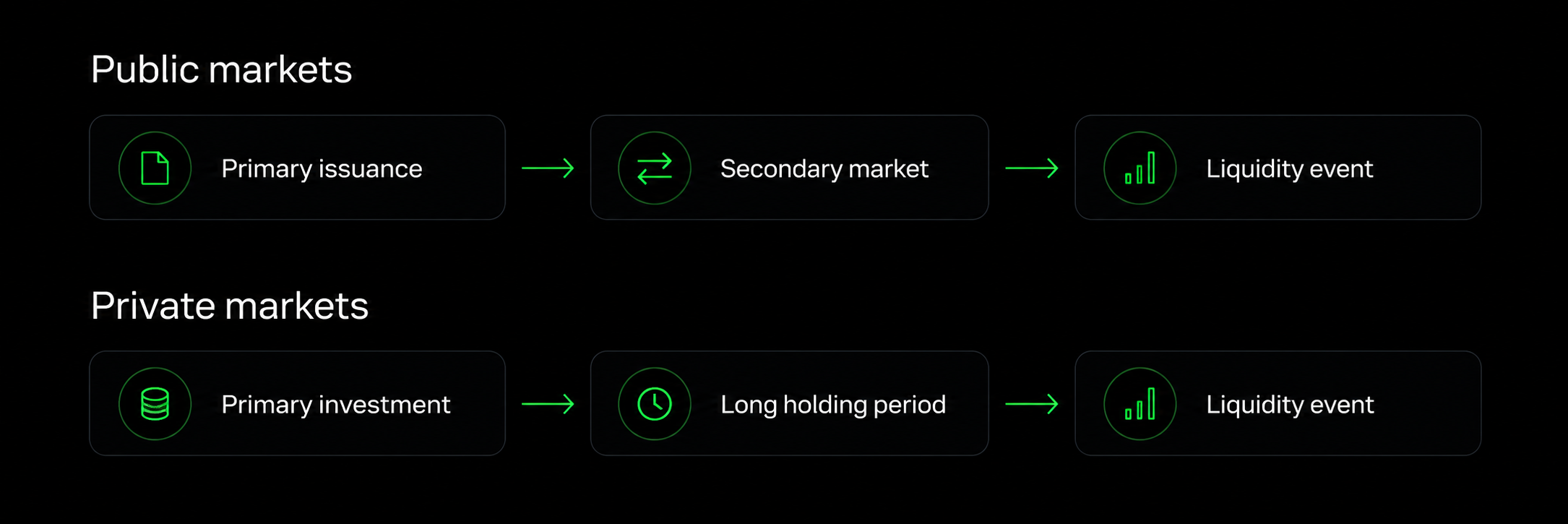
In public markets, the initial issuance of a security and the market where investors subsequently trade it are separate parts of the same system.
An investor does not generally need to wait for the underlying company to be acquired or reach another liquidity event before there is a market where the security can change hands. Where sufficient liquidity exists, buyers and sellers can transact with each other in the secondary market.
Private investments generally do not have the same continuous secondary market infrastructure. That distinction became the second major consideration behind RCM.
RCM is being built around the broader lifecycle of a private market position, rather than treating the initial investment as the end of the market structure.
The lifecycle begins with primary issuance. Subject to investor eligibility and applicable jurisdictional requirements, eligible investors can participate in an offering connected to an underlying private market position.
Following issuance, an RCM Asset can become transferable, allowing it to trade through secondary markets.
This creates a path for market participants to transact before the underlying private position itself reaches a liquidity event.
The important difference is that secondary market infrastructure is considered as part of the structure from the beginning.
Instead of designing the investment lifecycle solely around entering a private position and waiting for the underlying position to eventually be realized, RCM introduces infrastructure for secondary trading between those two points.
The existence of that infrastructure does not guarantee liquidity. Secondary trading ultimately depends on market participation, and there may be periods where limited or no liquidity is available.
If the underlying private position eventually reaches a liquidity event, that represents another stage of the RCM lifecycle, with any applicable distributions governed by the terms of the relevant RCM Asset.
Creating a path into selected private robotics opportunities addresses the first problem. Building market infrastructure around what happens after the investment has been made addresses the second.
But creating an onchain asset does not, by itself, create a functioning market.
That is where the next part of Building RCM begins.
XMAQUINA is a decentralized ecosystem, giving a global community early exposure to the world’s leading robotics companies before they disrupt trillion-dollar industries.
Join our Discord and connect with thousands of futurists building the XMAQUINA DAO.
Follow us on X for the latest updates.
Owner: