Building RCM 03
Minting an asset onchain does not create a market.
October 15, 2026
Category:
Physical AI
Read time:
6 minutes
Share This:
In Building RCM 02, we explored why access to a private investment is only one part of the problem. Even after an investor acquires a position, finding a way to transfer it can remain difficult until the underlying company reaches a liquidity event.
Blockchain introduces a different approach to how financial assets can be issued, transferred and connected to markets. But minting an asset onchain does not, by itself, create a functioning market.
In traditional private markets, secondary transactions often depend on intermediaries connecting buyers and sellers, negotiating terms, coordinating approvals and completing transfers through processes that can take considerable time.
Blockchain changes the technical foundation on which these markets can operate.
Assets issued onchain can interact with shared infrastructure that supports transparent transaction records, programmable transfers and settlement through blockchain networks.
Rather than every transaction requiring a separate process between counterparties and intermediaries, compatible assets can interact with established protocols through a common technical framework.
Decentralized exchanges, for example, allow independent market participants to establish trading pools, contribute liquidity and transact through smart contracts. This infrastructure can operate continuously, without requiring the issuer of an asset to operate the exchange or act as the counterparty to every transaction.
For private market exposure, this represents an important change in how secondary markets can be organized.
Instead of relying exclusively on individually arranged transactions, an onchain asset can potentially interact with decentralized markets where buyers, sellers and liquidity providers participate independently.
The distinction is between creating an asset and establishing the conditions for a market to develop around it.
An asset can exist on a blockchain without attracting buyers, sellers or liquidity providers. A functioning market still depends on participation, pricing and available liquidity. Blockchain provides the infrastructure through which that activity can take place.
Outside of secondary trading, blockchain introduces another important capability.
Financial applications built on compatible blockchain networks can interact with the same assets and infrastructure. This is commonly referred to as composability.
An asset that can interact with a decentralized exchange may also become compatible with other financial protocols, depending on its technical characteristics and the requirements of those applications.
For example, an RCM asset could potentially be used as collateral within a compatible lending protocol, while independent derivatives markets could develop instruments referencing its market price.
The broader implication is that an asset issued onchain does not necessarily have to remain confined to the platform through which it was created. It can potentially become part of a wider financial ecosystem in which independent protocols and market participants develop additional uses around compatible assets.
RCM is being built to connect selected private robotics investment positions to blockchain infrastructure through RCM Assets.
The objective is not for XMAQUINA to operate every secondary market or financial application that might eventually interact with those assets.
Instead, RCM is being developed so that its assets can interact with external market infrastructure, allowing independent participants to establish markets and develop additional applications.
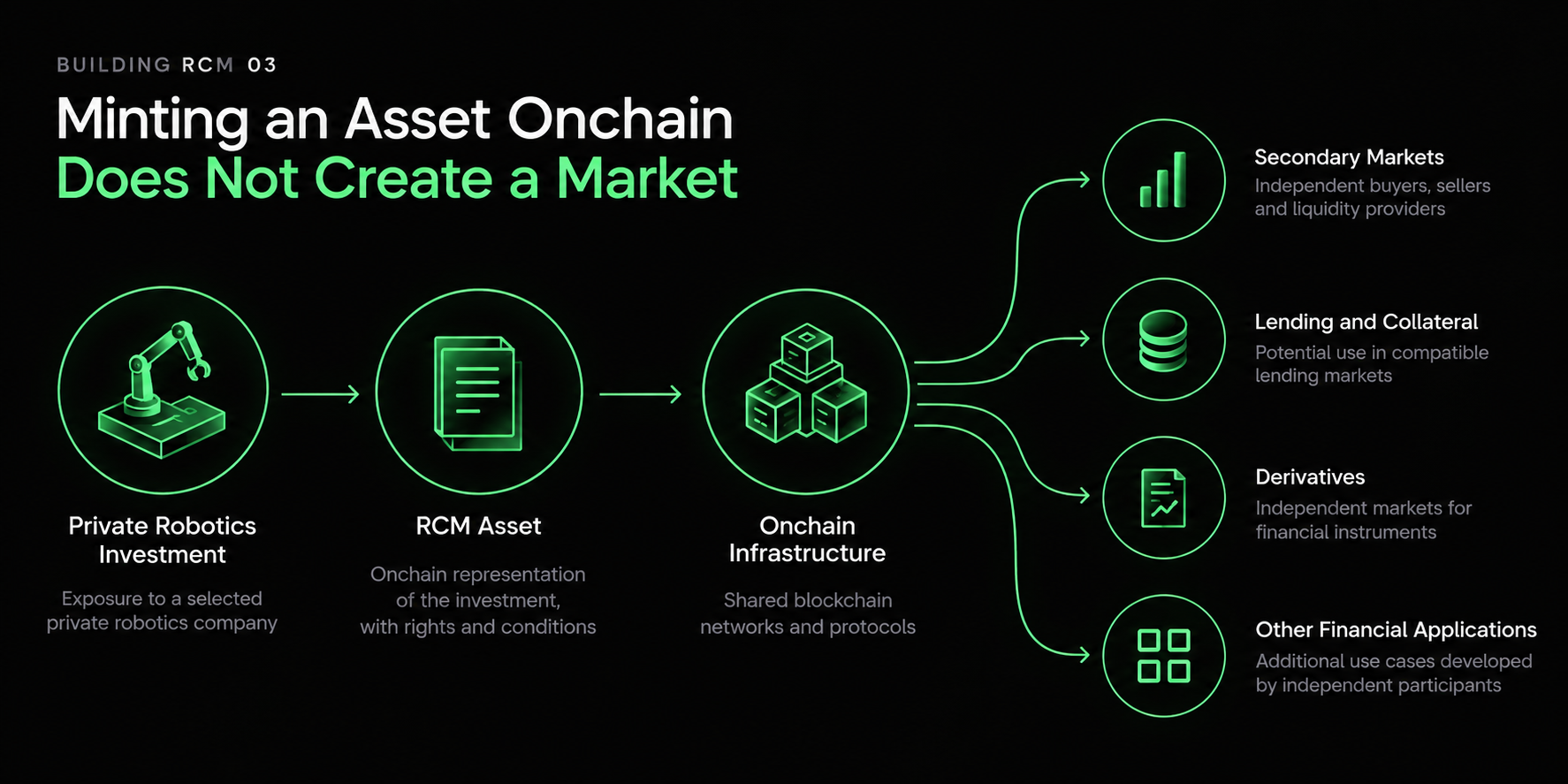
Private Robotics Investment → RCM Asset → Onchain Infrastructure
From Onchain Infrastructure, four branches connect to Secondary Markets, Lending and Collateral, Derivatives, Prediction Markets and Other Financial Applications.
RCM Assets remain connected to private market investments with legal rights, investor eligibility requirements and transfer conditions. Technical transferability does not automatically establish legal recognition or unrestricted trading rights.
Similarly, continuous blockchain infrastructure does not guarantee that a market will be available at any given time, that sufficient liquidity will exist or that an investor will be able to exit a position when desired.
These considerations are why RCM involves more than deploying a token contract. The underlying investment, legal structure, ownership records and smart contracts must work together to support the asset throughout its lifecycle.
What makes the approach different is that the infrastructure does not need to end with the initial issuance.
An RCM Asset can participate in a broader financial environment where independent markets and applications develop around it, rather than remaining isolated within a single investment platform.
For XMAQUINA, this is the direction behind RCM. Building infrastructure that connects selected private robotics investments to onchain capital markets while preserving the legal and operational requirements associated with those investments.
But before an RCM Asset can participate in any of these markets, there is a more fundamental question to answer.
What exactly does an investor hold when they acquire an RCM Asset, and how does that asset relate to the underlying private robotics investment?
That is where Building RCM 04 begins.
XMAQUINA is a decentralized ecosystem, giving a global community early exposure to the world’s leading robotics companies before they disrupt trillion-dollar industries.
Join our Discord and connect with thousands of futurists building the XMAQUINA DAO.
Follow us on X for the latest updates.
Owner: