

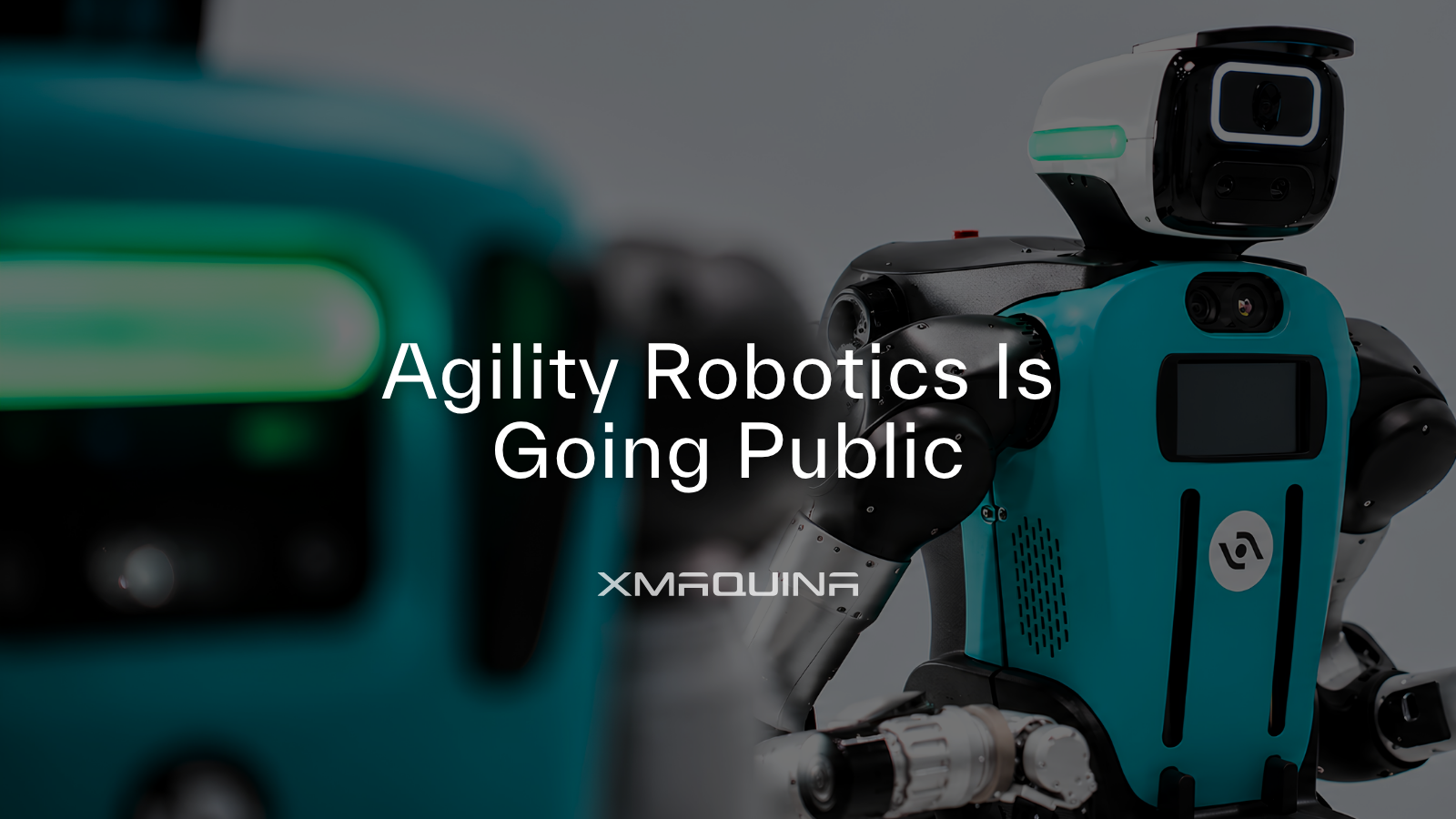
Agility Robotics Is Going Public
What the proposed SPAC transaction means for the DAO.
.png)
April 2, 2026
Category:
Physical AI
Read time:
8 minutes
Share This:
In March, Amazon expanded its humanoid footprint, Unitree stepped toward public markets, Washington drew new lines around robotics, and late‑stage capital concentrated even further at the top of the stack.
This month’s digest covers the key moves that matter for anyone positioning around humanoid robotics, autonomy, and infrastructure.
Amazon agreed to acquire Fauna Robotics, the company behind Sprout, a kid‑sized consumer humanoid designed for homes and social spaces.
Fauna gives Amazon a humanoid form factor that sits alongside its existing warehouse, logistics, and home device ecosystem, but is purpose‑built for domestic and social environments rather than industrial automation. Strategically, it’s another example of Amazon buying a proven robotics stack instead of building every modality in‑house.
Asimov introduced its “Here Be Dragons” DIY humanoid, a 1.2m open‑source robot that ships as a buildable kit based on off‑the‑shelf components.
By packaging an open platform into a documented, bench‑assemblable kit, Asimov lowers the bar for serious humanoid experimentation from well‑funded labs and corporates to individual builders, student teams, and smaller research groups. It’s a step toward treating humanoids more like developer hardware and less like bespoke R&D projects.
China’s Unitree, already one of the most aggressive legged‑robotics manufacturers, filed for an IPO in Shanghai targeting roughly $610M in proceeds.
Unitree plans to direct a large share of that capital into humanoid AI models and platform R&D, effectively using public markets to fund the next phase of its transition from quadrupeds into full humanoid systems. If successful, this listing would be one of the clearest tests of how public investors price humanoid exposure versus more traditional robotics and industrial plays.
Alongside Fauna, Amazon also moved to acquire Rivr, a Zurich‑based startup building four‑legged, stair‑climbing delivery robots for complex urban and residential environments.
Rivr slots into Amazon’s broader autonomy stack by tackling “doorstep and stairs” – the final meters that are hard to cover with wheeled platforms and traditional vans. Between Fauna and Rivr, Amazon is consolidating capabilities across home, last‑mile, and warehouse robotics, rather than betting on a single robot type to cover the entire chain.
In the U.S., lawmakers introduced the American Security Robotics Act, aimed at restricting government use of Chinese humanoid robots and related advanced robotics systems.
The bill effectively treats humanoid platforms, control stacks, and the data they generate as strategic infrastructure. It pushes questions about where systems are built, who maintains them, and how data flows across borders into the realm of national security, not just procurement. For humanoid vendors, this accelerates the split between domestic and foreign supply chains and raises the bar for compliance around public‑sector deployments.
New funding data highlights just how concentrated humanoid capital has become.
Figure AI and UBTECH alone account for roughly 3.5B in disclosed funding, and the ten most funded humanoid startups capture around 62% of all tracked capital in the category. The implication is clear: while new teams continue to form, late‑stage money is consolidating into a small set of platforms that investors view as credible paths to large fleets, not just compelling demos.

Sunday Robotics raised a 165M Series B at a 1.15B valuation to scale Memo, its autonomous home robot.
Memo is trained on tens of millions of real household episodes rather than curated lab teleoperation, aiming to learn directly from messy, real‑world human behavior. The round is one of the largest recent financings in consumer‑adjacent robotics, and it reinforces the view that the home remains a major long‑term frontier for embodied AI – provided teams can bridge the gap between demo‑ready behavior and safe, durable operation in unstructured environments.
XMAQUINA is a decentralized ecosystem, giving a global community early exposure to the world’s leading robotics companies before they disrupt trillion-dollar industries.
Now, you don’t have to be sidelined. Own the rise of humanoids.
Join our Discord and connect with thousands of futurists building the XMAQUINA DAO.
Follow us on X for the latest updates.
Owner:

.png)

