


Agility Robotics Is Going Public
What the proposed SPAC transaction means for the DAO.

May 18, 2026
Category:
Physical AI
Read time:
12 minutes
Share This:
Humanoid robotics is rapidly emerging as a new technological platform for artificial intelligence in the physical world. Capital investment in the sector is accelerating as companies develop general-purpose robotic systems capable of operating across industries from logistics to manufacturing.
Despite this momentum, access to the sector remains limited. Most of the innovation and capital formation occurs in private markets, with participation largely restricted to venture funds, institutions, and insider networks.
XMAQUINA was created to change that.
The DAO has established governance-led infrastructure designed to coordinate capital, liquidity, and ecosystem development within the humanoid robotics sector. Through decentralized governance, participants direct treasury deployment, ecosystem initiatives, and the development of infrastructure expanding access to robotics capital markets.
The activation of xDEUS introduces the next phase of governance for the ecosystem.
Governance determines how capital is deployed and how the ecosystem evolves. Its design is therefore critical.
Most DAOs rely on balance-based voting, where influence is determined purely by token ownership. In practice, this creates instability. Capital can be accumulated temporarily to influence decisions and withdrawn immediately after, with no long-term alignment.
XMAQUINA adopts a different approach.
The DAO uses a vote-escrow model, where governance influence reflects both capital commitment and time commitment. Participants stake DEUS to receive xDEUS, a non-transferable governance token. Voting power increases with the duration of the stake, meaning influence is earned through sustained participation rather than short-term positioning.
This structure reduces the risk of governance capture and aligns decision-making with long-term stakeholders. Short-term actors carry limited influence. Long-term participants shape the system.
-1.avif)
xDEUS is the vote-escrow governance token of the XMAQUINA DAO.
Governance participation begins when DEUS is staked. In return, participants mint xDEUS, which represents governance power within the DAO.
The mechanism is simple.

Governance influence increases as staking positions remain active, aligning decision-making power with sustained participation in the ecosystem.
For a deeper explanation of the mechanics, see the governance documentation.
XMAQUINA governance is powered by Aragon OSx, a modular and audited framework for building onchain organizations.
Unlike monolithic governance systems, OSx is built around a permission-based architecture that allows DAOs to compose governance logic through modular plugins. This design enables organizations to evolve their governance over time while maintaining transparent and enforceable onchain execution.
Within the XMAQUINA ecosystem, this infrastructure enables xDEUS holders to govern key functions of the DAO, including:
Because governance logic is modular, the system can expand as the ecosystem grows. New governance modules, voting mechanisms, or operational frameworks can be introduced without replacing the core DAO infrastructure.
All governance actions execute directly onchain through the Aragon framework, ensuring transparent and enforceable decision-making across the ecosystem.

With the introduction of xDEUS, the XMAQUINA is transitioning to a vote-escrow governance model.
To support this transition, 1,000,000 DEUS has been allocated to a governance activation program, emitted linearly over a fixed 90-day period beginning May 18 at 13:00 UTC. Rewards accrue over this period based on xDEUS participation and are distributed upon completion of the program.
Allocation is determined by each participant’s governance weight, as measured by xDEUS. As the staking base forms over time, early participants initially share rewards among fewer stakers, resulting in a larger share of the distribution.
Under the xDEUS model, voting power increases the longer DEUS remains staked. Each staking position begins with a base multiplier that grows over time, reaching up to a 12× multiplier after 12 months of continuous staking.
Beyond the initial activation program, xDEUS holders participate in governance over how value realized across the ecosystem is allocated, including protocol revenue and investment liquidity events. Where governance approves distribution, rewards are distributed to active xDEUS holders pro-rata based on multiplier-weighted balances.
This structure aligns governance authority, reward participation, and long-term commitment to the ecosystem.

Alongside the activation of xDEUS governance, the ecosystem introduces Humanoid Cards.
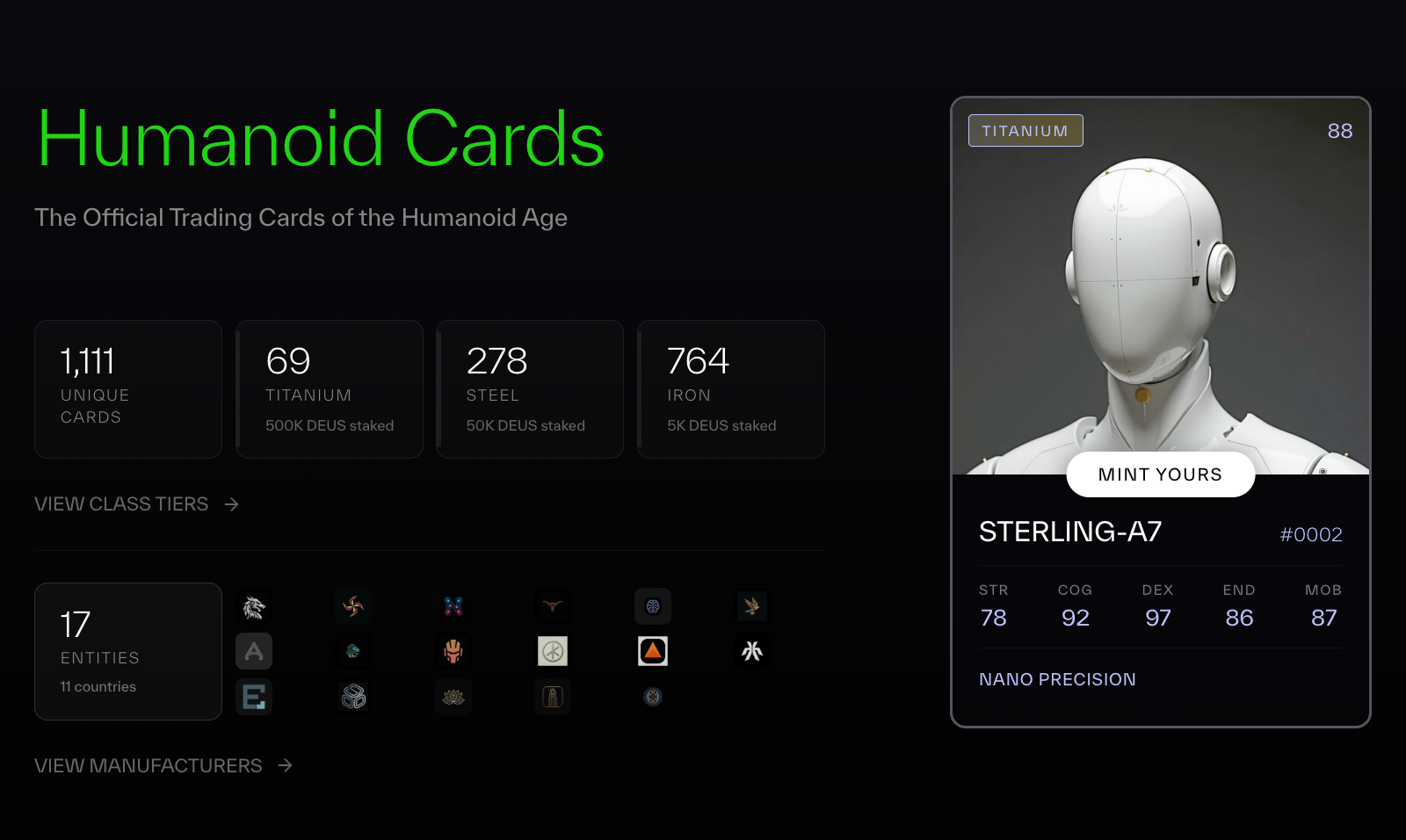
Humanoid Cards are limited edition digital trading cards minted by staking DEUS. Only 1,111 cards will ever exist.
They are not sold.
They are earned.
Each card represents an early contribution to the XMAQUINA ecosystem during the infrastructure phase of its governance layer. In this sense, Humanoid Cards function as permanent onchain credentials for participants who committed capital before the ecosystem reached scale.
Cards are organized into three classes based on staking tiers at the time of minting.

Humanoid Cards establish DAO rank within the ecosystem. They mark the wallets that participated early, contributing to Genesis Auctions that capitalized the DAO and later staking DEUS during the transition to the xDEUS vote-escrow governance model.
What that rank unlocks and how card utility evolves over time will be determined by DAO governance as the ecosystem evolves.
Explore the full Humanoid Cards experience.
.png)
xDEUS governance sits at the center of the XMAQUINA ecosystem.
The DAO treasury has already begun deploying capital into robotics ventures. Future allocations, portfolio adjustments, and new opportunities will be directed through xDEUS governance.
Beyond treasury activity, the ecosystem is expanding through the Robotics Capital Markets (RCM) protocol, designed to create onchain access to the humanoid robotics sector and enable token holders to participate in this emerging asset class.
In parallel, DEUS Labs incubates new ecosystem initiatives. The first project, Robotico, is already live, with future incubations guided through DAO governance.
What comes next is determined by xDEUS governance.
“Governance architecture determines the credibility and resilience of any onchain organization. By building on the Aragon OSx stack, XMAQUINA ensures governance that is secure, transparent, and time-aligned while remaining modular enough to evolve as the ecosystem scales.”
– Jessica Alvarez, Founding Member, XMAQUINA
“We built Aragon OSx to enable diverse organizations to design modular governance systems that can evolve with their needs. XMAQUINA’s application of the veToken model to humanoid robotics shows how flexible governance infrastructure can support innovation in emerging sectors.”
- Anthony Leutenegger, CEO, Aragon
Stake DEUS — dao.xmaquina.io/stake
Mint Your Humanoid Card — humanoid.cards
Enter the DAO Portal — dao.xmaquina.io
Owner:
.png)

