Building RCM 03
Minting an asset onchain does not create a market.
July 20, 2026
Category:
Physical AI
Read time:
9 minutes
Share This:
We have made the case for the humanoid form before. The human body is one of the most versatile, environment-compatible forms a general-purpose machine can take because the world itself was built around it. Our factories, warehouses, hospitals and homes were designed for people, not robots, and adapting a machine to fit those environments is often far easier than redesigning the environments themselves.
Over the past 18 months, that thesis has become considerably easier to defend. Capital markets started pricing humanoid robotics like an industrial category, and the robots themselves started showing up on real production lines warehouses, doing jobs companies could not otherwise staff.
The reasoning holds up because it was never really about robots looking futuristic. A humanoid can turn a doorknob, climb a stair built for a human stride, and pick up a tool sized for a human hand, without a single change to the building around it. Every other robot form factor, whether wheeled, tracked, or multi-armed, forces you to either redesign the environment or accept a narrower job description.
As NVIDIA CEO Jensen Huang put it on CNBC in 2024, the factory floor was built for people, and the only abundant dataset of physical labor in the world is footage of humans doing it. A robot shaped like us can learn from that dataset directly. A robot shaped like anything else has to translate it first.
That is the whole argument in two sentences. What follows is what happened when investors and operators started acting on it.

Humanoid robotics stopped being a niche venture category in 2025. Embodied Global tracked roughly $13.8 billion in global embodied-AI financing across 2025, up from $7.8 billion in 2024, and China's embodied-AI sector alone has attracted close to $80 billion in cumulative disclosed financing through April 2026.
On a narrower definition limited to humanoid-specific startups, PitchBook puts 2025 funding above $5 billion, up from just $239 million in 2022. Across all of robotics, Crunchbase recorded about $15 billion raised in 2025 and already $18.8 billion by mid-2026.
American and European rounds are being matched, and in China's case outpaced in volume, by a wave of domestic capital backing companies like Unitree, Galbot, AGIBOT, and UBTECH, which has topped up its balance sheet through several Hong Kong share placements over the past year.
Second, the size and diversity of investors has changed dramatically. Tether leading a $1.4 billion round into German robotics company, NEURA, and a stablecoin issuer becoming a lead investor in humanoid hardware, is not something we would have predicted when we first wrote about this space. Figure AI's $39 billion valuation in September 2025 remains the sector's high-water mark, but Skild AI and Neura Robotics both closed $1.4 billion rounds within the following nine months, which tells you the ceiling keeps moving up, not down.

The most persistent objection to humanoid robots is that they come for our jobs. The data from the last year says something closer to the opposite. They are showing up in roles employers have struggled to fill for years.
The US had more than 400,000 unfilled manufacturing positions as of December 2025, according to the Bureau of Labor Statistics, and roughly a quarter of the existing manufacturing workforce is 55 or older and heading toward retirement with no line of replacements behind them.
Agility Robotics' chief business officer described the pattern across every country his company operates in: "In Germany, Korea, Japan, or the US... they simply can't find the people to do this work". That is why Agility's Digit is now running inside Amazon, Schaeffler Group, GXO, and, as of this year, Toyota's Canadian manufacturing plant.
The pattern shows up at the auto parts level too. Schaeffler's plant in Cheraw, South Carolina is deploying Digit units into monotonous, repetitive physical roles across its footprint of 100 plants, and the company's own framing is not replacement but backfill.
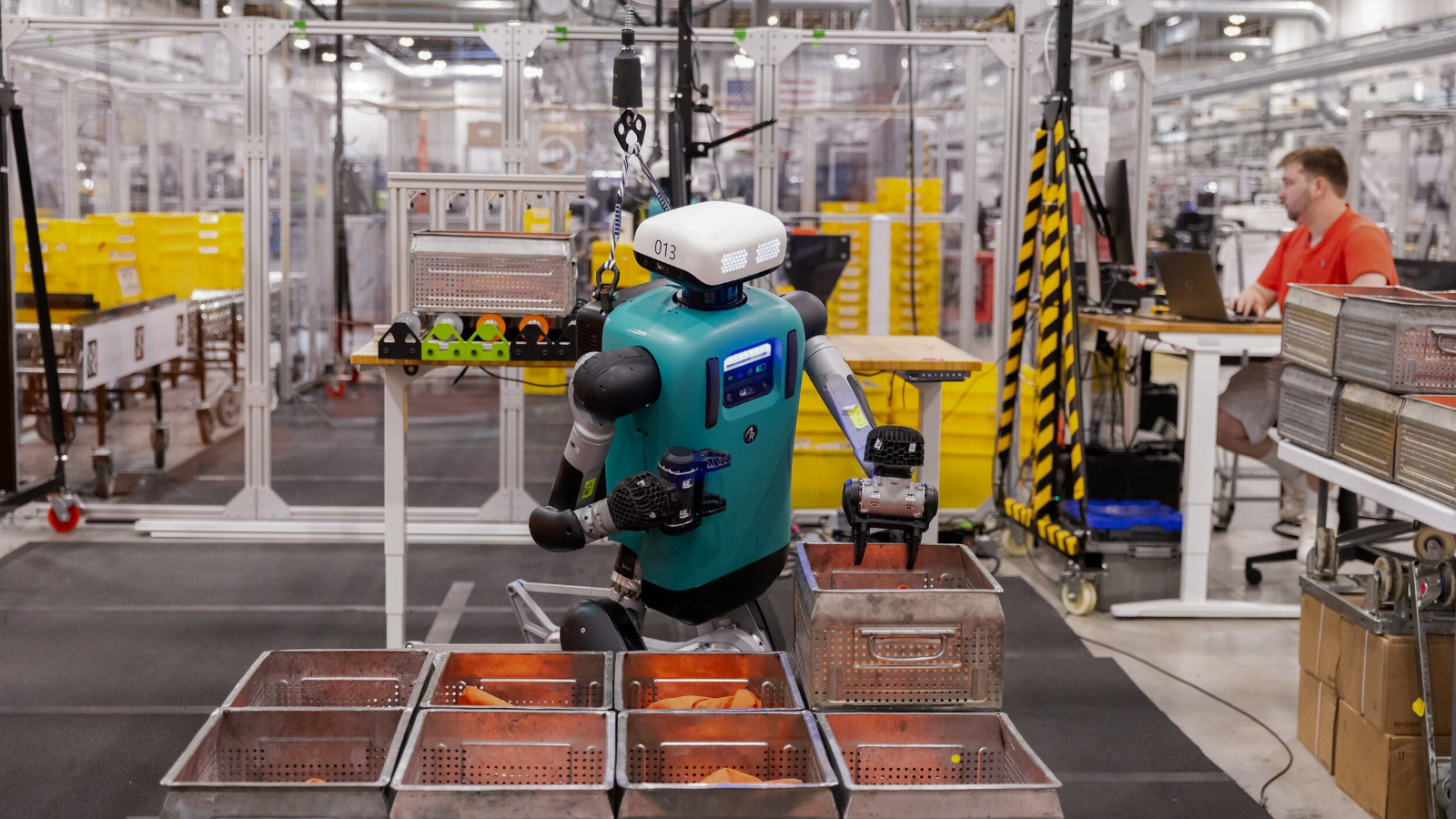
In China, humanoid robots have spent six months running night shifts at a Shenzhen logistics center, sorting same-day delivery packages after human staff go home. Their sorting rate climbed from 100 to 900 packages an hour over that stretch, reaching about 85 percent of human throughput, and if the deployment holds up, it directly addresses a night-shift staffing gap the facility could not otherwise close.
The same report describes eight humanoid quality inspectors running steady 3,000-hour shifts at a tablet factory in Nanchang, with 50 units planned by year-end.
The demographic pressure behind this is structural. China faces a projected 24.5 million labor deficit tied to its aging population, and BCG estimates that global labor imbalances could put $10 trillion of GDP at risk by 2030.
None of this means the transition is friction-free. This month, roughly 35,000 Hyundai workers in South Korea began a rolling strike, the first in any industry specifically triggered by a company's plans to bring humanoid robots onto the factory floor, even as wages and profit-sharing were also on the table.
What this dispute proves is that the deployments are real enough to bargain over, not that the underlying labor math has changed. The night shifts, elder-care rounds, and trailer-unloading docks these robots are filling were vacant long before any robot walked onto the floor.
The case for the humanoid form was always based on the idea that the market would validate the thesis through investment and real-world deployment. That is exactly what happened. Billions of dollars moved into the category across three continents, and the robots that money built went to work in the jobs employers could not fill on their own.
XMAQUINA is a decentralized ecosystem, giving a global community early exposure to the world’s leading robotics companies before they disrupt trillion-dollar industries.
Now, you don’t have to be sidelined. Own the rise of humanoids.
Join our Discord and connect with thousands of futurists building the XMAQUINA DAO.
Follow us on X for the latest updates.
Owner: