Building RCM 02
Access is only the beginning.
June 1, 2026
Category:
Physical AI
Read time:
12 minutes
Share This:
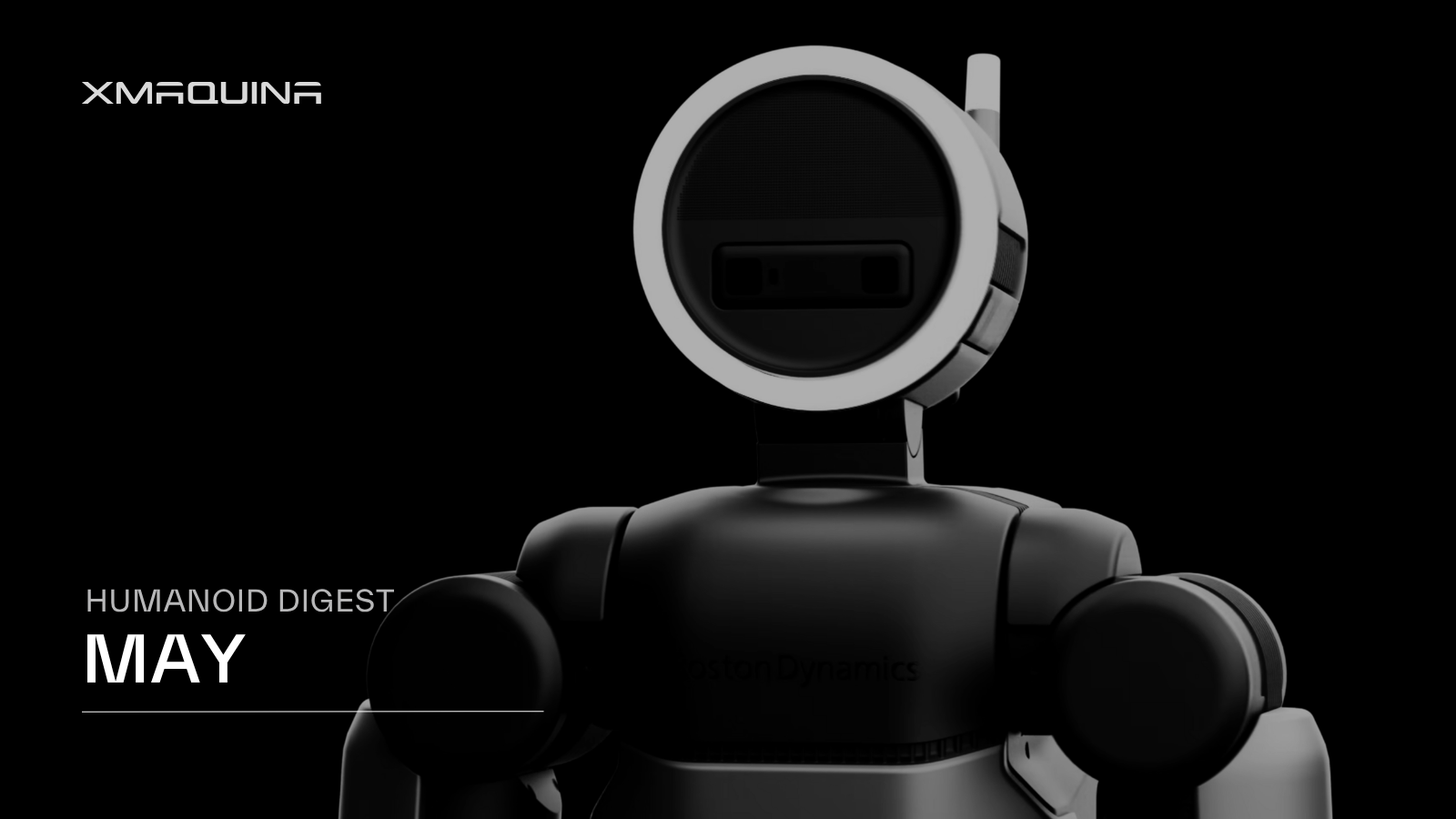
May has been the most consequential month for the humanoid robotics economy so far this year. Factories went live, deployment orders broke records, a major tech platform entered physical AI, and the first onchain market for robotics exposure launched publicly.
The industry’s acceleration continues to compress. What many expected to unfold over years is increasingly happening quarter by quarter.
Apptronik closed a $935 million funding round at a reported $5.3 billion valuation, one of the largest capital raises in the sector this year.
The company also expanded its executive bench with leadership from Waymo, Boston Dynamics, Amazon, and iRobot. Collectively, these executives have extensive experience scaling robotics products from research environments into commercial operations.
Apollo continues to advance through pilot programs with Mercedes-Benz, GXO, and Jabil as the company prepares for larger scale commercialization.
Hyundai committed to deploying 25,000 Boston Dynamics Atlas units across its U.S. manufacturing plants, with production scaling by 2028. It is the single largest humanoid deployment order ever recorded. The same week, Hyundai debuted Atlas at the FIFA World Cup 2026 as an official partner, with the robot trained to execute a rabona kick by studying real match footage.
The factory commitment and the World Cup appearance reinforce each other. The public debut gives Atlas a cultural identity; the manufacturing order gives that identity operational credibility. Running both simultaneously is a deliberate normalisation play across industrial and consumer audiences at once.
Figure ran a 10-hour live contest between a human intern and a Figure 03 robot on a package sorting task. The human narrowly won on throughput and finished the shift describing his forearm as "basically broken." The robot continued without incident. Ahead of the test, Figure had already ramped F.03 production from one unit per day to one unit per hour.
Publicly framing the contest as a direct comparison shifted the evaluation question from capability to competitiveness. A narrow human win on throughput, at the cost of physical strain, is a different result than the headline suggests, and it will read differently again once production has scaled further.
Figure announced a commercial partnership with Catalyst Brands to deploy Figure 03 at the Reno, Nevada distribution center serving JCPenney, Aéropostale, and Brooks Brothers. Catalyst operates 1,800 locations, roughly 60,000 employees, and $9 billion in annual revenue. The agreement is designed to scale across the full Brookfield portfolio. Figure is currently valued at $39 billion.
A holding company structure means expansion does not require renegotiation, it requires performance. Proving the robot works in one distribution center unlocks the entire portfolio, which is a more efficient go-to-market path than single-site agreements negotiated one at a time.
Meta acquired Assured Robot Intelligence (ARI), a San Diego startup building AI for humanoid whole-body control. Co-founders Lerrel Pinto and Xiaolong Wang, formerly of NVIDIA and UC San Diego, join Meta's Superintelligence Labs. The stated goal is physical AGI, built through learning directly from human experience. Terms were not disclosed.
Meta now combines hardware development capacity, one of the world's largest data infrastructures, and a dedicated humanoid research team. Most robotics AI efforts have lacked at least one of those three inputs. Acquiring a small team with specific whole-body control capabilities is faster than building that capability internally, and it marks the largest tech platforms moving from digital AI into physical intelligence through targeted acquisition.
EngineAI's Honghualing production facility is now operational. The line runs 79 quality checks per unit, simulates 46 working conditions, and is built to complete one T800 humanoid every 15 minutes at full capacity. The stated annual production target is 10,000 units.
A line capable of one robot every 15 minutes, with 79 embedded quality checks per unit, is industrial infrastructure. Chinese humanoid manufacturing is moving at a pace Western competitors have not yet matched, and volume at this scale begins to shift unit economics in ways that change the competitive picture for everyone else.
LimX Dynamics launched Luna, a humanoid designed for commercial and service environments. At 165cm tall with 33 degrees of freedom and fabric-wrapped surfaces, Luna is built for malls, events, and brand activations. One operator can synchronise up to 200 units simultaneously. LimX recently closed a $200 million Series B backed by JD.com, NIO Capital, and SAIC.
Most of May's humanoid announcements targeted industrial settings. Luna is built for environments where appearance, motion fluidity, and coordinated deployment matter more than raw throughput. The 200-unit synchronisation capability defines the commercial model: Luna is not priced for individual unit economics, it is priced for event-scale deployment, which is a distinct business from factory automation.
Unitree unveiled the GD01, a manned transformable mecha that swaps between bipedal and quadrupedal modes and is capable of carrying a human operator. It is priced from approximately $540,000 and billed as the world's first mass-produced civilian rideable robot.
The GD01 is not a humanoid in the conventional sense. The civilian framing, the transformable form factor, and the price point together mark Unitree extending its product range into an entirely new category, one that sits above industrial deployment in ambition and public visibility.
XMAQUINA launched the $DEUS Token Generation Event on May 27 on Base, via Aerodrome and Virtuals Protocol.
$DEUS is structured to give participants onchain access to the robotics economy. The treasury was built entirely through public auctions, with institutional and retail participants entering on identical terms. It is the first instrument of this kind built specifically around the humanoid sector.
XMAQUINA is a decentralized ecosystem, giving a global community early exposure to the world’s leading robotics companies before they disrupt trillion-dollar industries.
Now, you don’t have to be sidelined. Own the rise of humanoids.
Join our Discord and connect with thousands of futurists building the XMAQUINA DAO.
Follow us on X for the latest updates.
Owner: