Humanoid Digest: September 2026
Production volumes, commercial orders and new manufacturing infrastructure continued to expand across humanoid robotics.
February 19, 2026
Category:
Physical AI
Read time:
10 minutes
Share This:
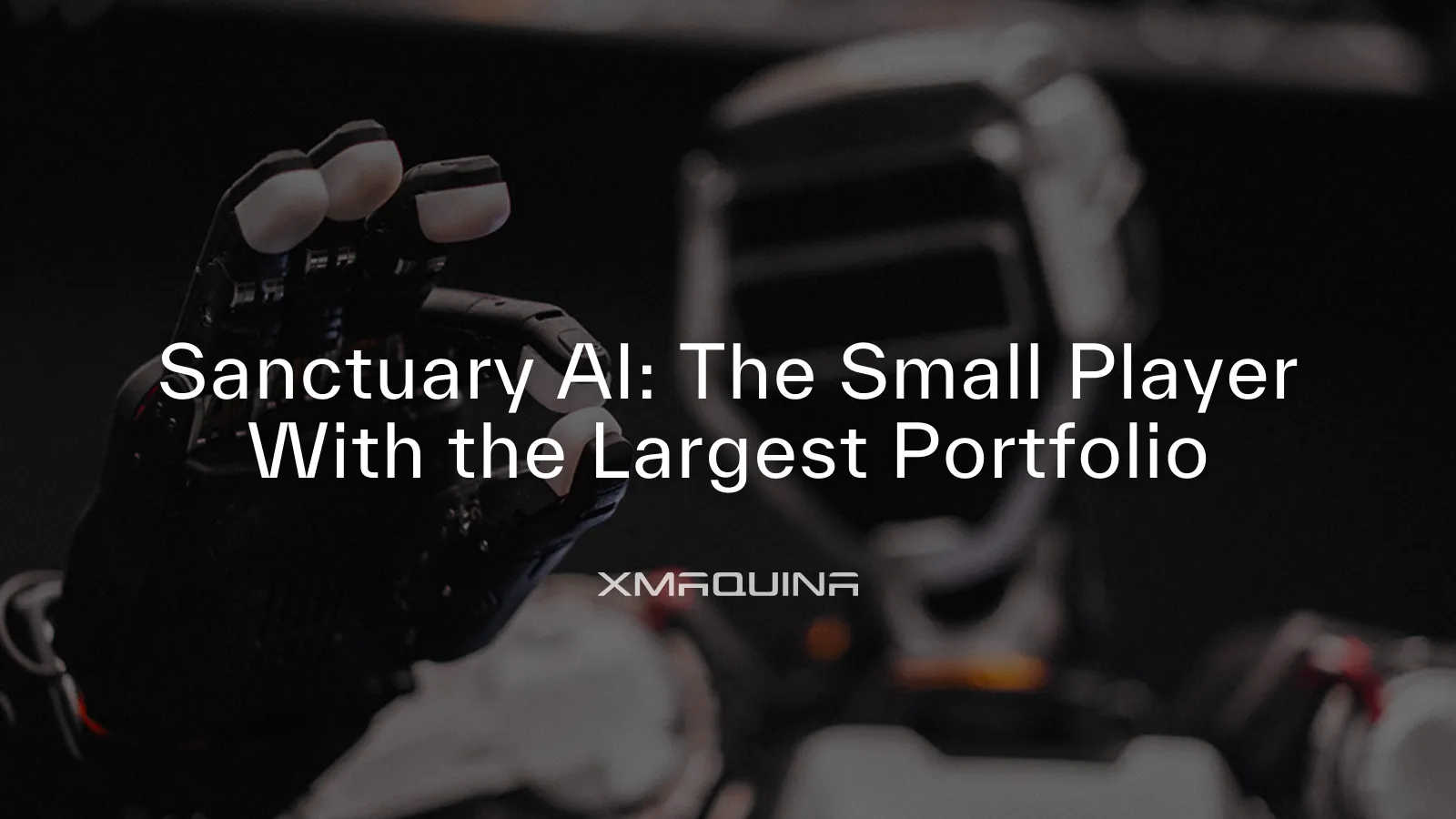
Every major humanoid robotics company started by trying to make robots walk. Sanctuary AI skipped that step and asked what would happen if robots could touch instead.
Founded in 2018 by Geordie Rose, the theoretical physicist who built the world's first commercial quantum computer at D-Wave, Sanctuary took an approach that seemed backwards to the industry. While competitors obsessed over bipedal locomotion and balance algorithms, Rose and his team focused on the human hand.
The core thesis: replicating human-level dexterity addresses 90% of useful work tasks. Walking addresses maybe 10%.
Today, Sanctuary holds approximately 140 published US patent filings. Morgan Stanley's "Humanoid 100" report ranked them third globally for published US patents in general-purpose robotics. Tech + IP Advisory independently ranked them fourth globally for patents in both general-purpose robotics and dexterous manipulation. PatentVest's May 2025 analysis went further: among over 11,000 humanoid robotics patent families, dominated by industrial giants like Sony, Honda, Toyota, Hyundai, Alphabet, and Samsung, Sanctuary AI is the only startup that ranks in the global top 20.
Despite over $2.1 billion in venture capital flowing into humanoid robotics startups, PatentVest found that most remain under-protected, with little or no intellectual property behind their rising valuations. As their report put it: "While Figure AI commands attention and capital, Sanctuary AI is quietly building one of the most defensible platforms in the category."
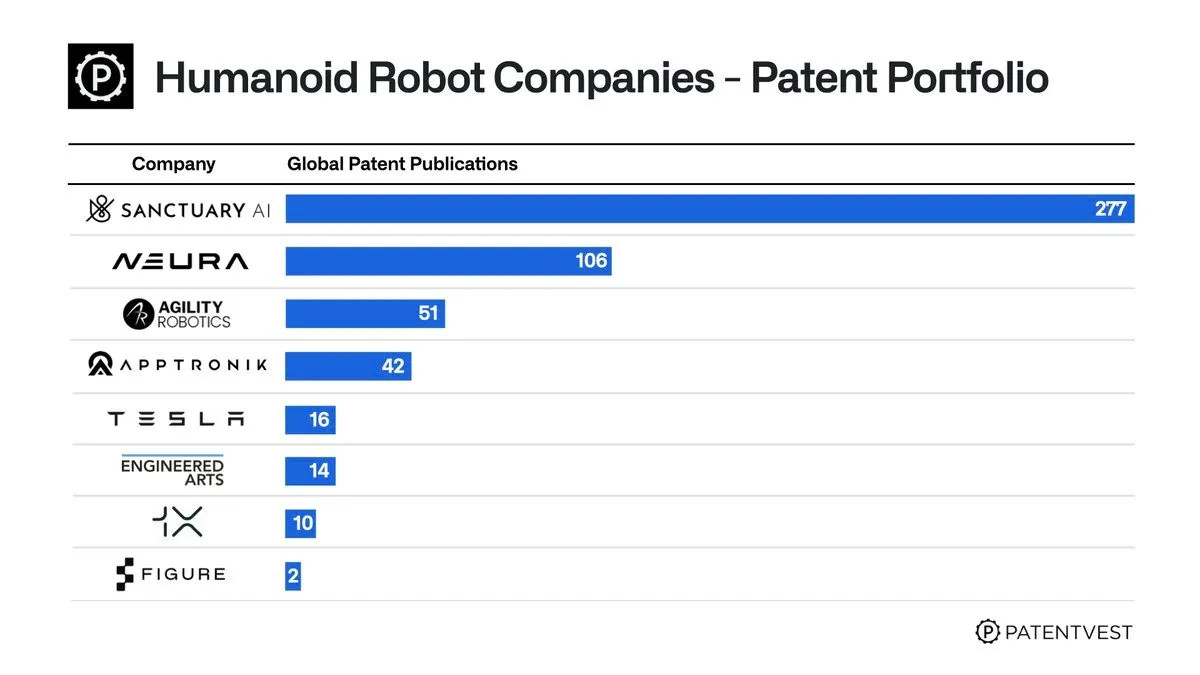
Sanctuary incorporated patents into its strategy early, through both internal R&D and strategic acquisitions.
Olivia Norton, co-founder and now Chief Technology and Product Officer, explains: "Our team is experienced in bringing world firsts to market, so we understood the importance of IP from the get-go. We have been working on the challenge of general-purpose AI humanoid robots for longer than most, which means we were able to identify and develop patents for the key technologies needed to bring this vision to life."
The patent portfolio spans the complete lifecycle of creating general-purpose AI humanoid robots: visual servoing, real-time grasping simulation, haptic-visual data mapping, teleoperation systems, tendon-based joint control with precision compensation, and detachable mechanical eye cartridges with multi-directional movement.
In December 2023, Sanctuary acquired additional IP from Giant.AI and Tangible Research, companies founded by Jeremy Fishel, now Sanctuary's Principal Researcher. The acquired patents cover haptic photogrammetry, environment models with haptic data, and touch-vision integration, all technologies vital for robots to manipulate objects in unstructured environments.
Morgan Stanley's report only captured 51 of Sanctuary's ~140 published US filings, just 36% of their actual portfolio. As the company noted: "This is really only the tip of the iceberg."
Manipulation accounts for the majority of useful work: picking items, folding clothes, operating tools, handling delicate objects, assembling components. These tasks require dexterity, not mobility.
James Wells, CEO and Chief Commercial Officer: "Dexterous capability is directly proportional to the size of the addressable market for general-purpose humanoid robots."
Dexterous hands allow deployment in stationary or limited-mobility contexts immediately, while locomotion improves over time. Walking without grasping leaves fewer practical use cases.
Phoenix, now in its eighth generation (launched January 2025), uses a wheeled base. This was a deliberate design decision informed by customer feedback that bipedal legs are too fragile to support a strong torso needed for precision industrial work. The robot has completed over 110 retail-related tasks during commercial deployments and has been tested across 400+ customer-defined tasks spanning 15 industries.
.webp)
Sanctuary's robotic hand features 21 degrees of freedom per hand, powered by miniaturized hydraulic valves approximately the size of a coin.
Why hydraulics? Nearly every other humanoid company has moved to electric actuators. Boston Dynamics abandoned hydraulics entirely when it redesigned Atlas in 2024. Figure AI, Tesla, Apptronik, 1X Technologies, Unitree, Neura Robotics are all electric. Electric motors are lighter, simpler, quieter, and easier to maintain.
Sanctuary disagrees. Their argument is that for hands specifically, hydraulics offer an order of magnitude higher power density than cable or electromechanical alternatives, with superior speed, strength, controllability, and impact resistance in a smaller package. For full-body locomotion, electric wins. For 21 degrees of freedom crammed into a human-sized hand, Sanctuary claims hydraulics are the only viable path.
If electric manipulation catches up, and companies like Figure and Tesla are investing heavily in exactly that, Sanctuary's core differentiator narrows. Their actuators have been tested through over 2 billion cycles without leakage or degradation, the equivalent of roughly 800 years of human hand use. But durability in a lab and scalability in manufacturing are different problems, and hydraulic systems carry inherent complexity that electric alternatives avoid.
Hydraulics for humanoid hands is a contrarian position, and probably the wrong one long-term. The weight of engineering talent and capital is moving toward electric, and when an entire industry converges on one approach, the outlier usually loses. Where Sanctuary's story gets interesting is not the actuator choice itself but everything built around it: the patent portfolio, the tactile sensing, the haptic-visual mapping, the AI control system. Those assets have value regardless of whether the final production hand runs on hydraulic fluid or electric motors.
The system operates at low pressure using food-safe oil, making it safe for operation around humans and in food-handling environments.
In February 2025, Sanctuary integrated a new generation of tactile sensors into Phoenix's finger pads. Each pad contains a 7-cell touch sensor array using micro-barometers, detecting forces as low as 5 millinewtons, within 40% of human fingertip sensitivity (3 mN). This enables blind picking, slippage detection, and prevention of excessive force, capabilities that competitors relying on vision-based manipulation alone do not currently offer.
By May 2025, Sanctuary demonstrated sim-to-real transfer of reinforcement learning policies for its hydraulic hands, successfully executing in-hand object reorientation against gravity with 500g of unexpected load.
Carbon, Sanctuary's proprietary AI control system, integrates touch and vision to understand physical interactions. Unlike vision-only systems, Carbon uses "enriched behavioral data" from tactile sensors to understand object properties like rigidity, weight, and surface texture.
As Fishel explains: "Without tactile sensing, robots depend on video to interact with their environment. With video alone, you don't know you've touched something until well after the collision has physically caused the object to move. This reduces work efficiency and can require numerous attempts. Touch solves this."
The seventh-generation Phoenix could learn new tasks in under 24 hours, down from weeks in earlier versions. Generation 8, optimized for high-fidelity data capture, pushes training quality even further with improved cameras and telemetry systems.
Both Carbon and the robotic hands are designed in modular formats for integration across multiple robotic platforms, making technology licensing a viable path alongside direct robot sales.
.webp)
Sanctuary has raised over $140 million since founding, with investors including Accenture, Magna International, Microsoft, Verizon Ventures, Workday Ventures, and the Canadian government ($30M Strategic Innovation Fund).
The May 2024 partnership with Microsoft focuses on embodied AI research, with Sanctuary accompanying Microsoft to Hannover Messe 2025, one of the world's largest industrial tradeshows. The Magna partnership addresses manufacturing scale: Magna, one of the world's largest automotive suppliers, will both use Phoenix robots in its facilities and potentially manufacture them at scale.
In November 2024, the board removed founder Geordie Rose as CEO. Co-founder Suzanne Gildert had departed earlier that year. James Wells, previously Chief Commercial Officer, took over as CEO, with Olivia Norton assuming both CTO and CPO roles.
The leadership transition adds uncertainty, though the core technical team and the patent portfolio remain intact. Wells' background is commercial rather than scientific, and the shift in emphasis toward deployment and revenue may follow.
Most coverage of humanoid robotics focuses on walking demos and billion-dollar funding rounds. PatentVest's analysis found that most of those billion-dollar startups have almost no IP protection. Over $2.1 billion invested, and the vast majority of startups remain underprotected.
Sanctuary is betting that the company controlling the best manipulation technology will win, even if others build better-walking robots. Being the only startup in the global top 20 for humanoid patent holdings, alongside Sony, Toyota, Honda, and Alphabet, creates real strategic options.
If general-purpose humanoids become a massive market, owning key IP around dexterity and manipulation creates leverage, whether through direct robot sales, technology licensing, or acquisition value. Morgan Stanley's own research states that Physical AI and general-purpose robots will address the $60 trillion annual labor market. PatentVest projects the humanoid market at $38 billion by 2035, with long-term estimates exceeding $7 trillion.
Sanctuary's miniaturized hydraulics, tactile sensing integration, haptic-visual mapping, and reinforcement learning for dexterous control are all protected by patents that competitors will need to navigate. Whether Sanctuary succeeds as an independent company or becomes a strategic acquisition target, the IP portfolio travels with the technology.
The technology works and the patents are filed. The remaining question is whether Sanctuary's capital position and market timing will let them commercialize it before larger, better-funded competitors close the manipulation gap.
XMAQUINA is a decentralized ecosystem, giving a global community early exposure to the world’s leading robotics companies before they disrupt trillion-dollar industries.
Now, you don’t have to be sidelined. Own the rise of humanoids.
Join our Discord and connect with thousands of futurists building the XMAQUINA DAO.
Follow us on X for the latest updates.
Owner: