

NEURA Is Building Something Much Larger Than 4NE1
With $1.4 billion in new capital, a growing robotics portfolio and top industrial partners, NEURA is assembling a much larger Physical AI ecosystem.

June 16, 2026
Category:
Physical AI
Read time:
9 minutes
Share This:
Before robots can act, they need to learn. Training requires not just “more data,” but highly structured interaction data that ties perception to force, contact, and outcome in the real world.
Scale AI has spent the past decade building the machinery to produce that kind of data at industrial scale. It began as a data-annotation startup and evolved into what it now calls an AI “data foundry,” supplying many of the leading commercial and government AI programs. Its move into Physical AI is an attempt to extend that same infrastructure into the domain of embodied systems, where the unit of work is no longer a document or an image, but a robot interacting with its environment.
Robotics introduces a different data problem. The training data that matters must be captured from real-world interaction or high-fidelity simulation aligned with real-world dynamics.
Scale is building the systems that turn those interactions into a continuous, repeatable asset.
Scale AI was founded in 2016 by Alexandr Wang, who left MIT at nineteen after working on applied machine learning projects and concluding that the limiting factor was not clever architectures but the quality and supply chain of data. He grew up in Los Alamos, New Mexico, the child of two physicists, and has consistently framed AI as a long-duration infrastructure problem.
The company’s early business focused on computer vision datasets for autonomous vehicles and defense customers. It built internal systems and offshore workforces to label images, video, and sensor streams via subsidiaries such as Remotasks and Outlier, which together formed a low-friction interface between Western AI developers and a global annotation workforce. That positioning expanded into LLM-era work as Scale began providing RLHF, evaluation, and red-teaming services for frontier model labs.
By 2024, Scale had raised a 1 billion dollar Series F at a 13.8 billion dollar valuation, with participation from NVIDIA, Meta, Amazon, and others, cementing its role as upstream infrastructure for the AI ecosystem. In parallel, the company deepened its relationship with the U.S. government, winning multiple nine-figure agreements across the Pentagon and intelligence community to clean, label, and evaluate sensitive datasets and to deploy purpose-built generative systems such as Donovan for defense analysts.

Most coverage stops at “Scale labels data for big models.” The more important story is what sits on its cap table and contract roster.
In 2025, Meta reportedly bought roughly 49 percent of Scale AI for about 14 to 15 billion dollars, implying a total valuation near 29 billion dollars and turning a single commercial platform into a quasi-strategic owner of the infrastructure that supplies its competitors. Nvidia, Amazon, and a long list of venture investors also hold stakes. This is not a neutral utility. It is a piece of infrastructure whose ownership is concentrated in a small set of the companies that benefit most from AI consolidation.
On the government side, Scale has become one of the most prominent data and model contractors for the U.S. defense establishment. In 2025 the company announced a five-year, 100 million dollar ceiling agreement with the DoD Chief Digital and Artificial Intelligence Office; by May 2026, that ceiling had been expanded to 500 million dollars, giving any Pentagon program a streamlined route into Scale’s data and model infrastructure at pre-negotiated terms. This sits alongside earlier large agreements with the Joint Artificial Intelligence Center and the U.S. Army for labeled sensor, imagery, and autonomy data.
Taken together, the ownership and contract structure makes Scale less of a “tool vendor” and more of a soft power node in the AI stack. It is where consumer platforms, capital markets, and national security interests converge.
When this footprint extends into robotics and Physical AI, the same data infrastructure that trains consumer models begins to train robots in industrial facilities and, over time, in defense and other dual‑use settings.
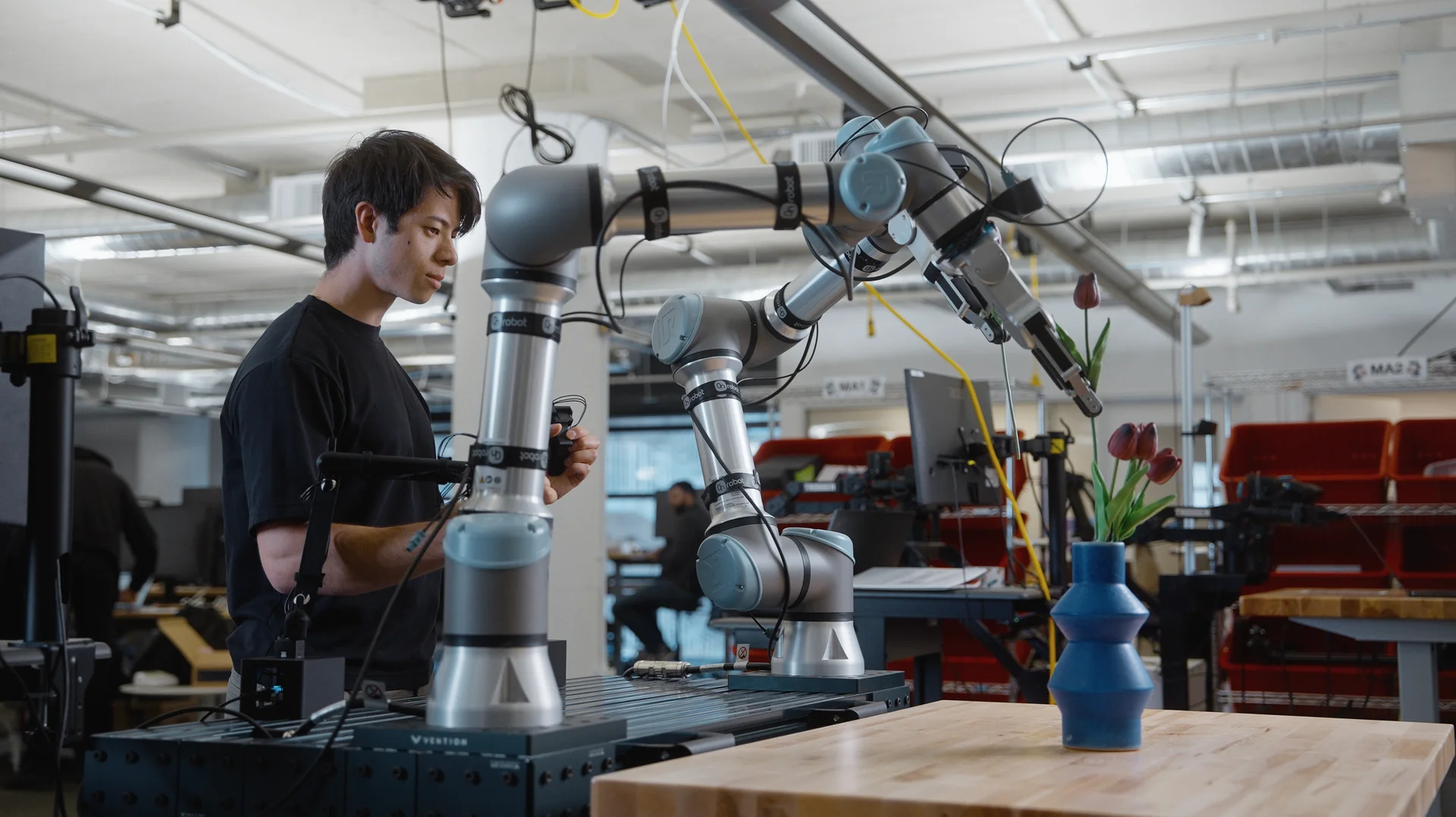
Scale’s collaboration with Universal Robots (UR) is where its Physical AI architecture becomes concrete. At NVIDIA GTC 2026, UR announced the UR AI Trainer, an imitation learning platform built with Scale to collect synchronized robot, vision, and force data on the same cobots already deployed in more than 100,000 industrial installations.
The system uses UR’s Direct Torque Control and force feedback to capture contact‑rich demonstrations that train vision‑language‑action models for real assembly, packaging, and handling work.
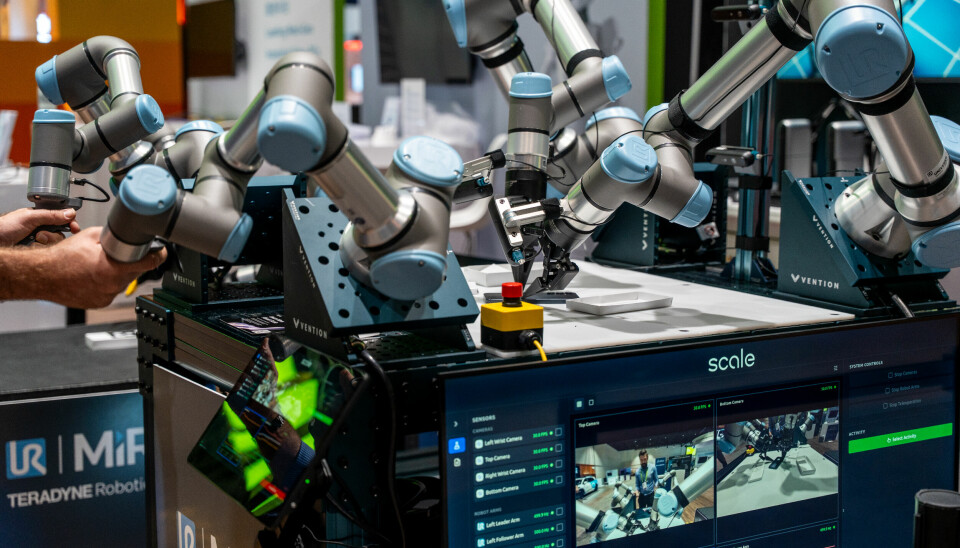
The important detail is provenance. Instead of training on research‑only hardware in a lab, the UR AI Trainer records multimodal traces on the exact robot models that run in factories: trajectories, torques, contact forces, and visual context guided by a human “leader” robot while a “follower” mirrors the motion. Those traces feed directly into Scale’s Physical AI engine and, aggregated across sites and customers, form reusable foundations for generalizable manipulation models.
NVIDIA’s simulation stack closes the loop. Universal Robots is exploring the NVIDIA Physical AI Data Factory blueprint and Isaac Sim to scale synthetic data generation, creating a pipeline where simulated demonstrations and real‑world traces inform the same models. It is the kind of multi‑source data regime humanoid systems will ultimately depend on, grounded in real contact dynamics, but broad enough to cover long‑tail edge cases.
From a humanoid robotics standpoint, Scale sits in a strategically sensitive position.
Humanoid companies will need training data that reflects human-scale manipulation in human-scale spaces: lifting, placing, handling tools, interacting with objects that were never designed for machines. They will also need evaluation regimes that surface failure modes before those systems are deployed into warehouses, logistics hubs, or defense contexts.
Scale already operates those evaluation regimes for LLMs, including targeted red-teaming and systematic weakness discovery. It is now extending that methodology into Physical AI by evaluating robotic performance against structured tasks and incorporating human feedback into model refinement.
At the same time, the company’s contracts with the Pentagon give it a privileged role in how AI, including autonomous systems, is operationalized in defense. As the DoD and allied defense establishments begin to explore humanoids and advanced field robotics, a data and evaluation provider with deep roots in both commercial and defense ecosystems becomes a gatekeeper.
Layered on top of that is ownership. With Meta reportedly holding roughly half of the equity and other major technology platforms also on the cap table, the infrastructure that trains embodied models may be partially controlled by the same actors that dominate consumer AI and compute.
Scale AI is not building the humanoid itself. It is building part of the infrastructure that determines which humanoid systems improve fastest, generalize best, and reach deployment with enough reliability to matter. In a robotics market increasingly defined by data quality, evaluation, and iteration speed, that is a powerful position to occupy.
XMAQUINA is a decentralized ecosystem, giving a global community early exposure to the world’s leading robotics companies before they disrupt trillion-dollar industries.
Now, you don’t have to be sidelined. Own the rise of humanoids.
Join our Discord and connect with thousands of futurists building the XMAQUINA DAO.
Follow us on X for the latest updates.
Owner:
.png)
.png)

