Skild AI and the Business of Building Robot Intelligence
From foundation models to industrial deployments and more than $100 million in reported annual recurring revenue.
October 21, 2026
Category:
Physical AI
Read time:
8 minutes
Share This:
A year ago, Skild AI was attracting attention for its ambition to build a universal brain for robots. Today, the Pittsburgh-based company is reporting more than $100 million in annual recurring revenue, working with some of the world’s largest industrial robotics manufacturers and developing AI models that can learn new tasks from a single video.
Founded in 2023 by Carnegie Mellon University researchers Deepak Pathak and Abhinav Gupta, Skild AI has become one of the most valuable private companies in robotics. Its $1.4 billion Series C in January 2026, led by SoftBank, valued the company at more than $14 billion.
The round attracted NVIDIA’s NVentures, Macquarie Capital and Bezos Expeditions, alongside existing investors Lightspeed, Felicis, Coatue and Sequoia Capital.
The financing gives Skild AI substantial resources to develop its technology and expand commercial operations, with a business focused on the intelligence behind robots.
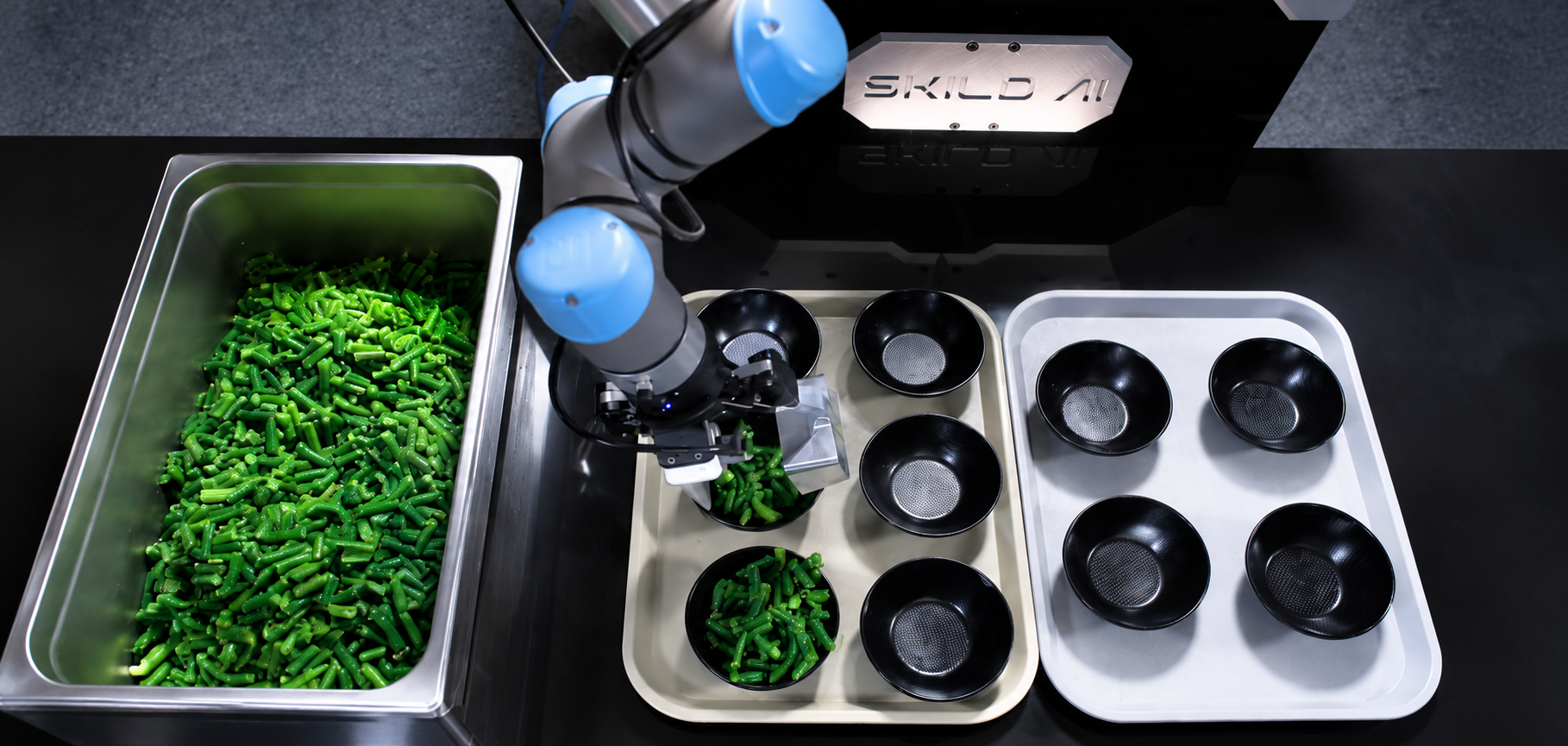
Skild AI’s commercial expansion accelerated in March when it announced partnerships with ABB Robotics, Universal Robots and Mobile Industrial Robots. The collaborations aim to integrate its foundation models into established industrial robotic systems, helping manufacturers automate tasks that would otherwise require extensive programming.
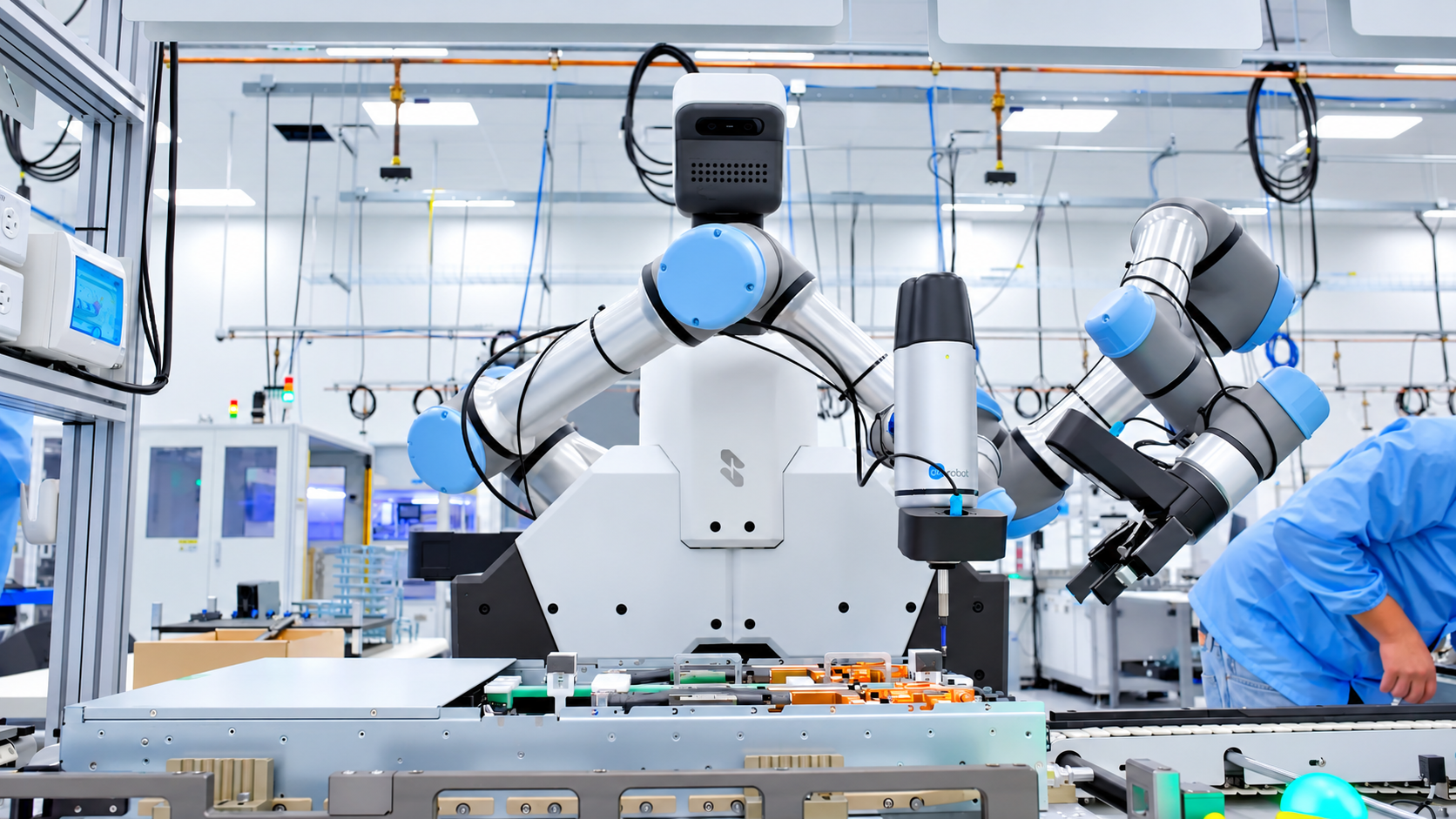
The company is also working with NVIDIA and Foxconn on high-precision assembly of NVIDIA’s Blackwell computing systems. Demonstrations have shown dual-arm robots positioning components and fastening screws, offering an early look at how general-purpose intelligence could handle demanding manufacturing operations.
In April, Skild AI acquired Zebra Technologies’ robotics division, formerly known as Fetch Robotics. The acquisition brought an established warehouse automation business into the company, including autonomous mobile robots and the Symmetry Fulfillment platform.
It also gives Skild AI a foothold in warehouse automation, where robots are already operating commercially, and access to practical experience that could help improve its models.
In August, Skild AI introduced S1, its latest robotics foundation model, demonstrating a different approach to teaching robots unfamiliar tasks.
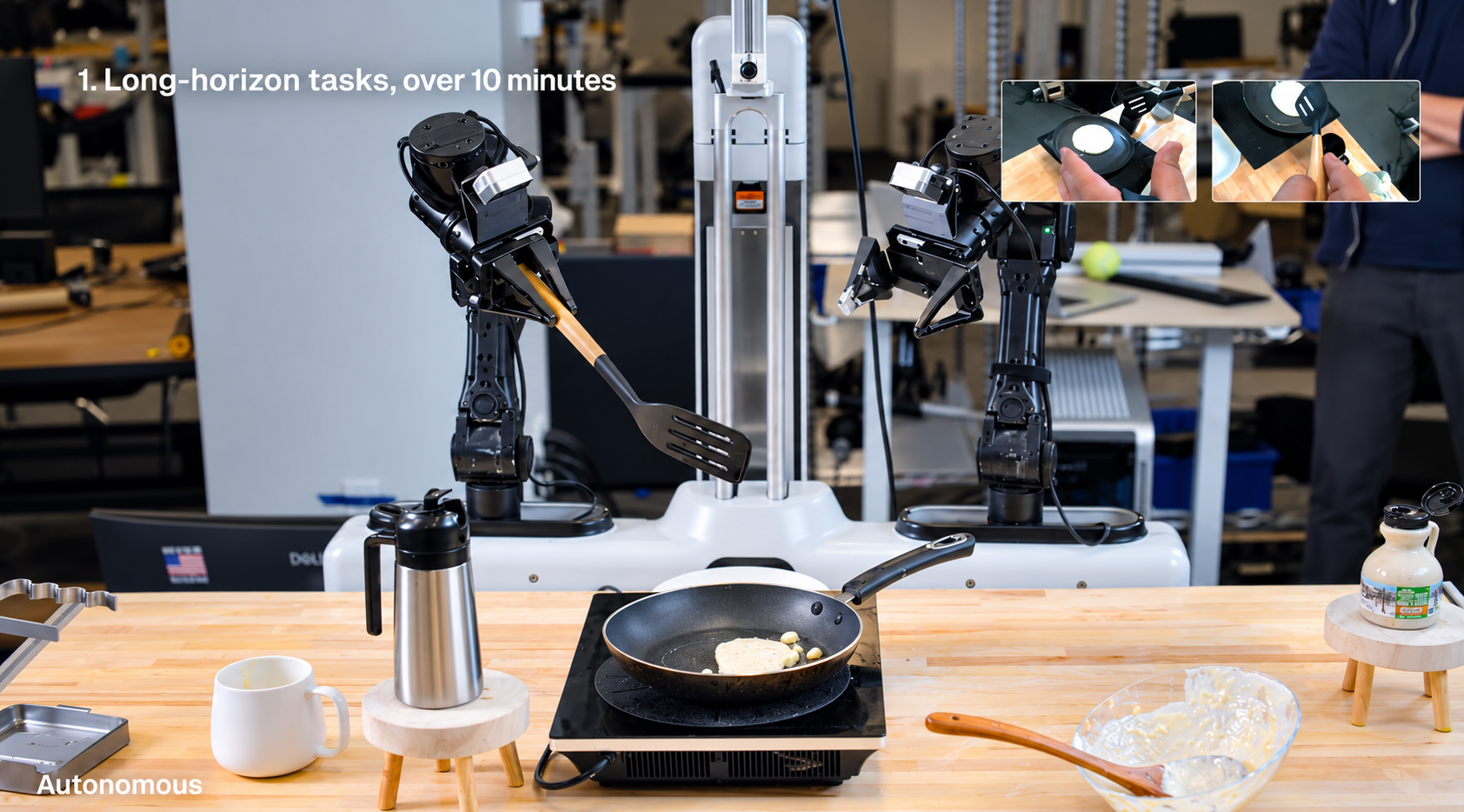
Rather than collecting extensive task-specific training data, S1 can learn from a video showing what needs to be done. The model interprets the demonstration and attempts to reproduce the task without additional training.
Skild AI demonstrated robots preparing pancakes, brewing coffee, assembling components and potting plants. Some tasks involved sequences lasting up to ten minutes, including activities the model had never encountered during training.
In one demonstration, S1 began executing a plant-potting task just 11 minutes after the instructional video was recorded.
The company’s internal evaluations reported a 66% cumulative per-step success rate on unseen tasks, compared with 9% for a language-prompted baseline trained on the same amount of data. Although these are company-reported research results, they suggest that video-based learning could reduce the effort required to introduce new robotic tasks.
Skild AI followed this with another research demonstration in September, using NVIDIA Isaac Sim to train a robot through physical self-play.
After more than 140 simulated years of soccer, the model had developed increasingly sophisticated movements and strategies, which were subsequently transferred to a physical humanoid robot.
Although still experimental, the research shows how simulation could help robots acquire complex physical skills without relying entirely on human demonstrations.
Skild AI’s most significant commercial milestone came in September, when the company reported surpassing $100 million in annual recurring revenue just ten months after its first commercial deployment.
According to co-founders Pathak and Gupta, Skild AI had more than 60 paying customers and had recognized approximately $50 million in revenue. Around 90% of its reported revenue came from robotic manipulation, with the remaining 10% generated through mobility applications, including its acquired warehouse robotics business.
Among its customers is Sumitomo Wiring Systems, where Skild AI is working toward automating complex wire-harness manufacturing processes. In Japan, Mitsui & Co. is piloting S1-powered robots in commercial kitchens, while its collaboration with NVIDIA and Foxconn focuses on precision assembly.
The company has also expanded into inspection applications, with Pittsburgh International Airport testing quadruped robots powered by Skild AI software.
Skild AI’s founders have acknowledged the difficulty of making these systems reliable. In one example, the team needed a week to teach a robot to cook its first egg, followed by another two months to make the task consistently repeatable.
Getting a robot to complete a task once is one thing. Getting it to repeat that task reliably in a working environment is another.
XMAQUINA’s portfolio already includes leading humanoid manufacturers such as Figure AI, Apptronik and 1X Technologies. Skild AI offers exposure to another part of the robotics industry… the intelligence that could power machines across multiple manufacturers and applications.
Its commercial growth is particularly interesting because much of its business comes from industrial robotics rather than humanoids. Manufacturing and warehouse automation provide established markets for Physical AI, while advances in general-purpose models could support more capable humanoid systems as the technology develops.
For XMAQUINA, Skild AI would complement its existing portfolio, adding exposure to foundational robotics intelligence alongside its investments in humanoid manufacturers.
The DAO is preparing to bring a new investment proposal, BOT-15: Strategic Allocation in Skild AI, to a community governance vote.
The proposal will outline the proposed allocation, investment structure, valuation considerations and associated risks, giving DEUS governance participants the information needed to evaluate the opportunity.
XMAQUINA is a decentralized ecosystem, giving a global community early exposure to the world’s leading robotics companies before they disrupt trillion-dollar industries.
Join our Discord and connect with thousands of futurists building the XMAQUINA DAO.
Follow us on X for the latest updates.
Owner: